A division of Brown Enterprises

Brown Coding
Enterprises

We write the software cultural projects need. And every now and then something everyone needs, like the household shopping list.

What it is

Brown Coding Enterprises is the part of Brown Enterprises that writes code. It grew out of a practical problem: the outreach projects we run — festivals, exhibitions, teaching programmes — sooner or later ask for a digital tool that doesn’t exist yet, or that exists but costs as much as a whole edition and forces the project to bend into the shape of the product.

So we build them ourselves. And since software written for a festival looks a lot like software written for a school or a household, what we learn on one project ends up in the next.

We don’t sell shrink‑wrapped licences: we build applications for the people organising something, and we keep them running for years.

How we build them

Six decisions that hold for everything we write, and that you notice while using it.

They open in a browser

They are installable web apps: you open an address and, if you like them, you put them on the Home screen in three taps. No store, no review queue, no update to download.

They work where there’s no signal

A festival in a moat, a basement supermarket, a wood. The places where an app is genuinely useful are often the places with no reception: what matters stays on the device and catches up on its own.

No profiling

No advertising, no data resold, the bare minimum of personal information. Wherever accounts can be avoided, we avoid them.

Languages, where they matter

A festival hosting researchers from half the world can’t publish its programme in Italian only. Translations are part of the structure, not a patch applied at the end.

A back office for the organisers

The public‑facing half is half the work. The other half is the panel that handles guests, bookings, shifts and exports — the part that decides whether an edition runs smoothly or gets spent on spreadsheets.

They’re cheap to keep running

Static pages served from the edge and a managed Postgres: no server to administer, and running costs a cultural association can afford through the eleven months when nothing is happening.

The software

Three products in production, used every day by people doing the shopping, visiting a festival and taking a class outdoors to look at nature.

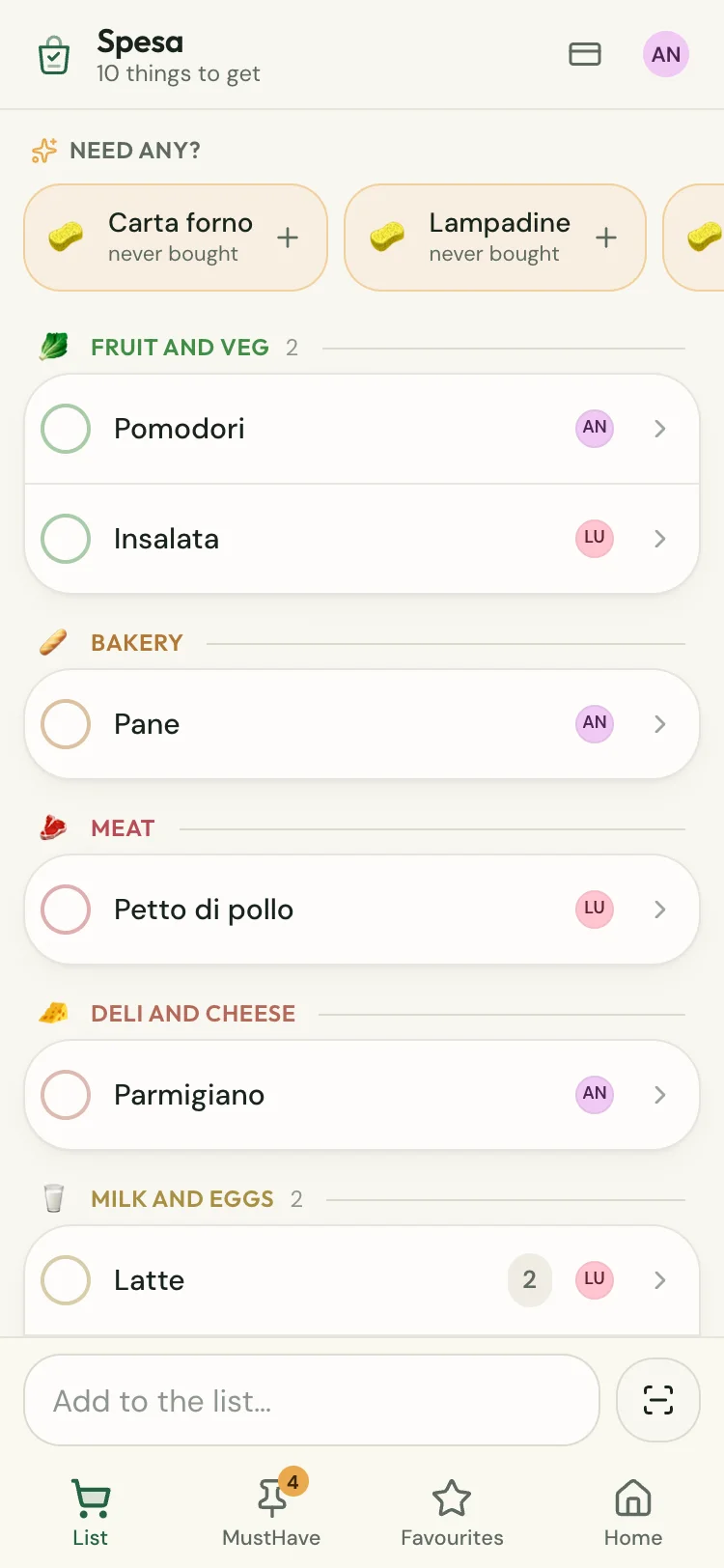
The SpesaDistesa shopping list, sorted by aisle
Product

SpesaDistesa

The household shopping list, shared by everyone who lives there. It sorts itself the way the aisles are laid out, learns what you buy again and again, and reminds you of the things that run out without warning. No accounts, no ads, in four languages.

Logo of Fosforo, the science festival
Platform

Fosforo.me

The portal of Fosforo — the science festival of Senigallia. Programme, QR‑code bookings, a guest area, school registrations and a control room that holds speakers, stands, meals and travel together. In six languages.

ECO App icon
Project app

ECO App

Local biodiversity in your pocket: twenty cards to explore, a quiz, six downloadable teaching units and the Guida Galattica alla Biodiversità. Built for Ecosistema di Comunità, a project supported by Fondazione Cariverona.

What they are made of

Few technologies, chosen because they last and because anyone who knows them can open the code five years from now.

ReactNext.jsTypeScriptViteTailwind CSS SupabasePostgreSQLRow Level SecurityVercel Progressive Web AppService WorkerWeb PushStripe
The rules that matter live in the database, not in the JavaScript: an app running in a browser is public code, and anyone who wants to get around a check written there needs two minutes. What must not happen is prevented by Postgres.

An idea to channel?

If you run a festival, an exhibition, a teaching programme or an association drowning in spreadsheets, tell us about it: the tool you need probably looks a lot like something we have already built.